 |
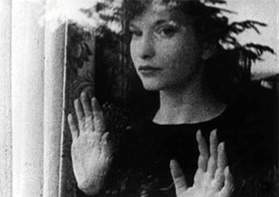
| Image from Meshes of the Afternoon (Maya Deren and Alexander Hammid, 1943) |
Maya Deren is recognizable as the woman with the enigmatic expression at the window, silently observing from within. Although her eyes indicate distrust, she is not desperate to escape her domestic space, but she is not entirely comfortable immured behind the glass. This image symbolizes some of Deren’s most significant initiatives in experimental cinema. In this still shot she establishes a silent connection with the eyes, suggesting the possibility for reverie or even hallucination. It foreshadows her experiments with superimposition and the juxtaposition of disparate spaces. It is an image that suggests the most compelling themes of her film work: dreaming, reflection, rhythm, vision, ritual and identity.[Wendy Haslem, 'Maya Deren', Senses of Cinema, 23, 2002]
It seems to me that in many films, very often in the opening passages, you get the camera establishing the mood, and, when it does that, cinematically, those sections are quite different from the rest of the film. You know, if it’s establishing New York, you get a montage of images, that is, a poetic construct, after which what follows is a dramatic construct that is essentially “horizontal” in its development. The same thing would apply to the dream sequences. They occur at a moment when the intensification is carried out not by action but by the illumination of that moment. Now the short films, to my mind (and they are short because it is difficult to maintain such intensity for a long period of time), are comparable to lyric poems, and they are completely a “vertical,” or what I would call a poetic construct, and they are complete as such. [Maya Deren, "Poetry in the Film", Film Culture Reader, ed. P. Adams Sitney, Praeger Press, New York, 1970, cited by Jonathan Rosenbaum, 'Independent America, 1978-1988', Moving Image Source, January 26, 2009]Film Studies For Free has the very great pleasure of bringing to your attention the Maya Deren Season at the British Film Institute between October 4-12 (click on this link for the full programme and booking details).
This blog is particularly looking forward to the book launch and lecture, this Friday, by Sussex colleague John David Rhodes, author of the then-to-be-launched BFI Film Classics study of Deren and Alexander Hammid's 1943 Meshes of the Afternoon - a wonderful tome FSFF has already read in its entirety, and from which you can read an enticing, free extract online.
To celebrate this season, and the most remarkable film artist to whom it is devoted, FSFF has put together a rather fabulous list, below, of openly accessible online scholarly studies of Deren's work, together with links to a couple of her written texts and some online videos of (and about) her work.
Taken together, the evidence of all these sources belies the apparent staticness of the iconographic image of Deren shown above: instead, she really was 'the Lara Croft of Jungian [and other psychogeographical and cinematic] terrains', as Mike Walsh jokingly, but memorably, put it.
- Maya Deren, "Cinematography: The Creative Use of Reality," in The Avant-Garde Film: A Reader of Theory and Criticism, ed. P. Adams Sitney (New York: Anthology Film Archives, 1978), pp. 60-73
- Maya Deren, 'Four Unpublished Poems', World Picture, 4.1, 2010
- David Andrews, 'Revisiting “The Two Avant-Gardes”', Jump Cut, 52, Summer 2010
- Rebecca Bachman, 'In the Mirror of Maya Deren', Senses of Cinema, 35, 2005
- Harmony Bench, 'Anti-Gravitational Choreographies: Strategies of Mobility in Screendance', The International Journal of Screendance, 1.1, 2010
- Karen Berger, '‘In Search of the Thing Itself’ – Africans in the Art of Two Ukrainian/American Jewish Artists: Maya Deren (1917 - 1961) and Clarice Lispector (1920 – 1977)', AFSAAP Conference 2010 (WORD Document)
- Karen Berger, 'The White Darkness: Confluences in the Imaginative Explorations of Identity and ‘the Other’ in the Work of Three Jewish Woman Artists in the Tropics - Maya Deren (1917 - 1961) in Haiti, Clarice Lispector (1920 - 1977) in Brazil, and Hélène Cixous (1937 - ) in Algeria', Refereed Proceedings of the Inaugural Tropics of the Imagination Conference, 2-3 November 2009. etropic: electronic journal of studies in the tropics, Vol 9 (2010)
- Erin Brannigan, 'Maya Deren, Dance, and Gestural Encounters in Ritual in Transfigured Time', Senses of Cinema, 22, 2002
- Erin Brannigan, '[Review of ] Bill Nichols (ed.) Maya Deren and the American avant-garde, Berkeley: University of California Press, 2001', Screening the Past, 2003
- Noël Carroll, 'Toward a Definition of Moving-Picture Dance', originally in Dance Research Journal, 2001; reprinted in The International Journal of Screendance, 1.1, 2010
- Louise Fenton, Representations of Voodoo: the history and influence of Haitian Vodou within the cultural productions of Britain and America since 1850, PhD Thesis, University of Warwick, 2009
- John Fox, 'The Other Side of the Gaze: Ethnographic Allegory in the Early Films of Maya Deren', REBUS, Issue 1, Spring 2008
- Christiana Galanopoulou and Alla Kovgan, 'In the Mirror of Maya Deren: Curators’ texts', Soith East Dance, [date unknown]
- Orit Halpern, 'Anagram, Gestalt, Game in Maya Deren: Reconfiguring the Image in Post-war Cinema', Postmodern Culture, 19.3, 2009
- Christopher C.P. Hanson, One more time: Instances, Applications and Implications of the Replay, PhD Thesis, USC, 2010
- Wendy Haslem, 'Maya Deren', Senses of Cinema, 23, 2002
- Ilona Hongistu, 'Towards Embodied Knowledge? Maya Deren’s Divine Horsemen – The Living Gods of Haiti and the rupture of ethnographic documentary film', Wider Screen, 2, 2002
- Lewis Jacobs, 'Experimental Cinema in America - Part Two: The Postwar Revival', in Eric L. Smoodin, and Ann Martin (eds), Hollywood Quarterly (Berkeley: University of California Press, 2002)
- Brett Kashmere, 'Underground Film, Into the Light: Two Sides of the Projected Image in American Art, 1945-1975', Synoptique, 8, 2005
- Andrei Khrenov, 'Fragmented Self in a Shattered Mirror: Martina Kudlacek's In the Mirror of Maya Deren (2001)."Kinoeye, 2 (20): 2002
- Pamela Mansbridge, Metaphor, male/female theorists, and the "birth rites" of women, the reclamation projects of Sylvia Plath, Anais Nin and Maya Deren, MA Thesis, University of Manitoba, 2000
- Jonas Mekas, 'Two Memories of Alexander-Sasha Hammid', Logos, Summer 2004
- William Moritz, 'Visual Music and Film-As-An-Art Before 1950', in Paul J. Karlstrom (ed.), On the edge of America: California modernist art, 1900-1950 (Berkeley: University of California Press, 1996)
- Elinor Pearson, 'Mute Movement: Score and Silence in the work of Maya Deren', Forum 4, April 2008
- Judith Marie Plessis, Femininity and Authorship: Deren, Duras and Von Trotta, PhD Thesis, University of British Columbia, 1995
- John David Rhodes, [excerpt from] Meshes of the Afternoon (London: BFI/Palgrave, 2011)
- Rebecca Sheehan, 'The Time of Sculpture: Film, Photography and Auguste Rodin', Screening the Past, 29, 2010
- Jonathan Rosenbaum, 'Independent America, 1978-1988', Moving Image Source, January 26, 2009
- P. Adams Sitney, 'Meshes of the afternoon' in Visionary Film: The American Avant-Garde, 1943- 2000 (New York: Oxford University Press, 2002)
- Marina Warner, 'Dancing the White Darkness', Tate Etc. Magazine, Issue 10, 2007
- Alan Weiss, 'Deren's Ritual (A tale from The Aphoristic Theater)', public 15 (1997): Icons and Idols
- Chirstinn Whyte, 'The Evolution of the ‘A’ Word: Changing Notions of Professional Practice in Avant-garde Film and Contemporary Screendance', The International Journal of Screendance, 1.1, 2010
Meshes of the Afternoon (Maya Deren and Alexander Hammid, 1943)
Maya Deren, Collected Experimental Films, 1986 (with C. Ito - New York: Mystic Fire Video)
Modern Women: Barbara Hammer on Maya Deren
Modern Women: Barbara Hammer on Maya Deren
